Yes — with a rule you set before you draw, and with one thing understood: the tally is the weakest part of the method, and it is not old. A yes/no reading is a real thing you can do with a real deck; what it is not is a tradition. The rules most pages teach — count to thirteen, reds are yes and blacks are no, count the pips — are a modern reader convention, and I could not find a source for any of them in a canonical tarot text or a pre-20th-century manual.
Why a bare yes or no wastes the reading
A spread can hold a situation, an obstacle and a direction. A verdict holds one bit — yes or no — and it throws away everything else that was on the table. If the answer is no, you learn nothing about why, or about what would change it.
The older tarot texts are supposed to settle this argument, so it is worth looking at what the founding one actually does. A. E. Waite's The Pictorial Key to the Tarot (1911) is where modern tarot reading starts, and it contains no yes/no method and no counting method at all: in a full-text search of the whole book, the word "yes" does not appear once. But Waite does ask closed questions. In Part III he writes: "Shall I be successful in my lawsuit?" And he answers it with a Significator and a ten-card spread whose positions are all descriptive — what covers the matter, what crosses it, what crowns it. No position returns yes or no.
So "you cannot ask cards a closed question" is not the finding. The tradition engaged the closed question and answered it with description. The tension is not yes/no against tarot; it is verdict against description — and you can have both, as long as you know which is which.
One more thing worth saying plainly, because it is the honest limit of any structured reading. Under uncertainty, structure feels meaningful. The 2008 study by Whitson and Galinsky is called "Lacking control increases illusory pattern perception", and that is the effect it reports: threaten someone's sense of control and they see more pattern in noise. That cuts both ways, and it should. It explains why a well-run yes/no reading genuinely helps someone who is stuck, and it is also the reason to check your hits against your misses instead of only remembering the hits.
The three-card yes/no spread
This is the method this article teaches. It is a modern convention. Nobody in the historical record teaches it, it cites no tradition, and it is offered here as a working tool rather than an inheritance. What it does that a single card cannot is give you a verdict and a reason in one draw.
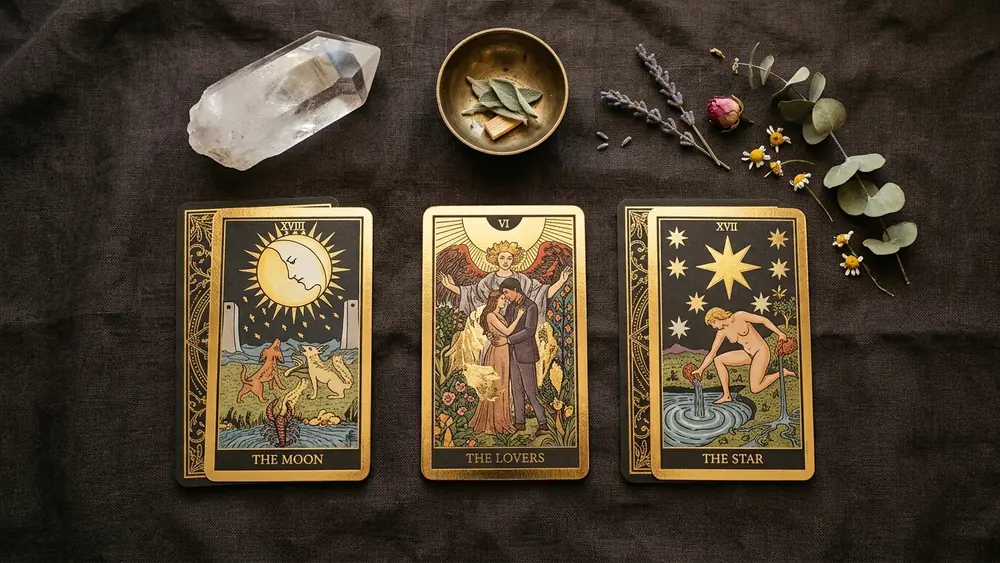
Set the question first — one sentence, closed, answerable with yes or no. Then deal three cards face up, left to right.
What each position answers
The situation. What you are actually standing in, as opposed to the story you tell about it.
What decides it. The force doing the work — the thing that will tip this one way or the other.
Where it is heading. The direction it takes if nothing changes between now and then.
Hold each card to its job. If the first card reads like an outcome, read it again as a description of the present. Fixed positions are what stop three cards from meaning anything you like.
How to deal it
Write the question down before you shuffle. One closed sentence, in your own words.
Decide the rule before you deal: which orientation counts as yes, how many upright cards you need, and what a split means. Decide it now, in writing — the method only works if you cannot choose the rule after seeing the cards.
Shuffle with reversals in the deck. If every card is the same way up, there is nothing to count at all.
Lay three cards face up, left to right.
Read the three positions as description, in order, before you count anything. Say out loud what each card is saying about its position.
Then count the uprights and read the verdict.
Finish with one sentence: the verdict, the reason, and the condition. If you cannot get it into one sentence, the draw came out split, and the split is telling you something about the question — see below.
How to count the answer
There is no single counting rule. Several incompatible systems circulate under the same name — one counts orientation, one counts suit colour, one counts whether a rank is odd or even — and none of them cites an origin. The same three cards can come out yes under one and no under another. What follows is the convention used in this article: a convention, chosen for being checkable, not a rule handed down from anywhere.
The tally, and what it means
Upright counts as yes. Reversed counts as no.
Count the upright cards. The majority is the verdict.
A split verdict is not a hedge. It is the condition.
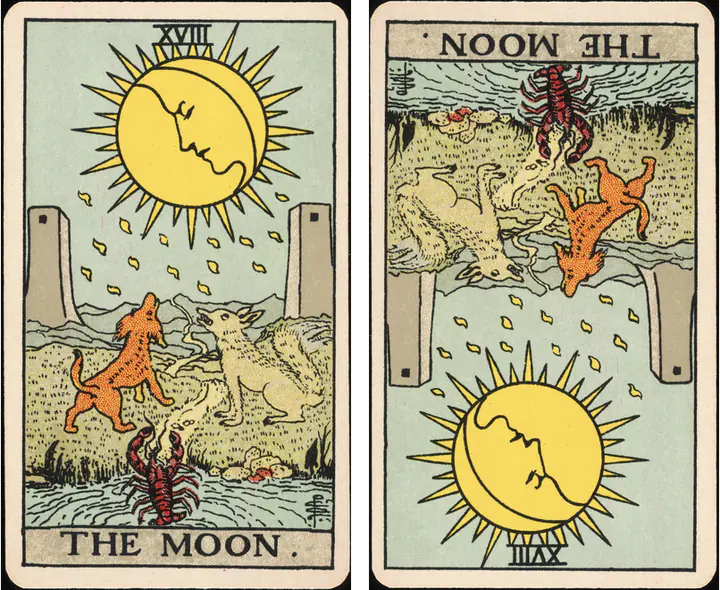
One card, and the same card turned. The tally above reads the first as yes and the second as no — a convention chosen for this article, not a property of the card. Art by Pamela Colman Smith. Beinecke Rare Book and Manuscript Library, Yale University, via Wikimedia Commons. Public domain.
Upright cards
Verdict
How often, at a 50/50 reversal rate
3
Yes
0.125
2
Yes, with a condition
0.375
1
No, with a condition
0.375
0
No
0.125
This four-band tally is our own; no published page I could find states it in this form. The arithmetic is not ours to claim as a discovery — it is arithmetic, and you can check it on the back of an envelope.
What the count is actually measuring
Here is the part almost no page says out loud. If your deck reverses about half its cards and you count uprights, your question never enters the arithmetic.
Three cards, two or more upright — a yes under the tally above — happens with probability exactly 0.5, whatever you asked. Five cards, three or more upright: also exactly 0.5. Any odd number of cards with a strict majority rule: exactly 0.5. At a 50/50 reversal rate, the spread is a fair coin, and a coin is not a comment on your question.
Change one thing and the coin changes. If nine cards in ten come up upright — the ordinary result of a deck you have not deliberately reversed — the same three-card rule returns yes about 97% of the time, assuming the cards fall independently. With no reversals at all, it returns yes every single time. Either way the output is a function of your reversal rate. That is the parameter that decides the answer, and it is the one nobody names.
The guides that do get this right state the precondition: they instruct you to shuffle your deck so that roughly half the cards are reversed, ensuring a balanced distribution. That instruction is not a detail. It is the entire mechanism. Conversely, asserting that "reversals always indicate no" as an inherent property of the card without checking deck orientation overlooks the underlying mathematics entirely.
Two limits on the claim, because it is easy to overreach with it. First, it applies to rules that count orientation — upright against reversed. It does not apply to rules that read card identity, such as "the Ace of Cups means yes": that is a meaning, and its probability belongs to the meanings, not to this arithmetic. Second, the four-band tally is ours, and the numbers beside it are arithmetic rather than a citation.
Unless you control the reversal rate, a yes/no spread is a fair coin wearing a spread's clothing.
Where these rules come from
Not everything about asking cards closed questions is modern, and the article would be wrong if it said so.
Counted-card layouts are old.The Original Norwood Gipsy; or, The Fortune-Teller's Sure Guide (Derby: Thomas Richardson, c.1840) tells the reader to "count nine" from the representative card: "the ninth card every way is of the greatest consequence". Foli counts in fives and nines in Fortune-telling by Cards (1900). Grand Orient's A Manual of Cartomancy (4th edition, 1909) counts nine cards every way. Orsini counts in sevens; a French Grand Jeu of 1845 counts to the twelfth card.
Closed questions answered from cards are old too. Foli's 1900 chapter "Important Questions" has the dealer discard eleven cards and then reads the answer off named cards inside a counted window: "If the seven of diamonds comes out in the first fifteen cards, the answer is 'Yes.' If the five of hearts and the seven of clubs appear instead among the first fifteen, it means 'No.'" That is a yes/no answer from cards, in a printed manual, in 1900. Telling Fortunes by Cards (c.1916) counts aces across three deals of thirteen for much the same purpose, though what it returns is a wish granted or not — its own words are "the wish will be granted", not yes or no. People have been asking cards closed questions for well over a century.
What has no traceable source is the specific apparatus taught today.
"Count to thirteen." The interval is never thirteen in any 19th-century manual I could find. It is five, seven, nine, or eleven and twelve. Where thirteen does turn up in the record it is a multiplier — Etteilla counted "treize fois 8 font 104" in the 1770s to produce a number, usually of years — or a deal size for a wish-omen, or a calendar allegory in Singer's 1816 history of playing cards. The one real lineage for a thirteen-card stop rule is Eden Gray's Three Aces spread in Mastering the Tarot (1971): you deal until an Ace appears or the thirteenth card does, then start again, three times over. That is 1971, and it is a three-pile oracle rather than the three-card spread taught today. So the mechanic has a source. The framing around it does not.
"Reds yes, blacks no." I could not find a pre-1930 source. It is not in Waite (1911), not in Telling Fortunes by Cards (c.1916), and not in The Square of Sevens (1897). The earliest binary red/black verdict I could find is in Hyatt's Folk-Lore from Adams County, Illinois (1935), and even there the verdict is "married" or "not married" rather than yes or no. Older sources use red and black for favourability, or for people's colouring, not for a binary answer. And the field does not agree on it: among the pages ranking for this query, exactly one mentions colour at all, and that page refuses to assign it.
"Count the pips, reds yes / blacks no", as one combined rule. I could not find it anywhere with a source attached.
And a hard ceiling on how old any of it can be. Tarot divination itself only begins in the 1780s — Dummett dates it to then, after playing-card fortune-telling had already been established for two decades. Whatever else a yes/no tarot rule is, it cannot be a tradition older than tarot reading.
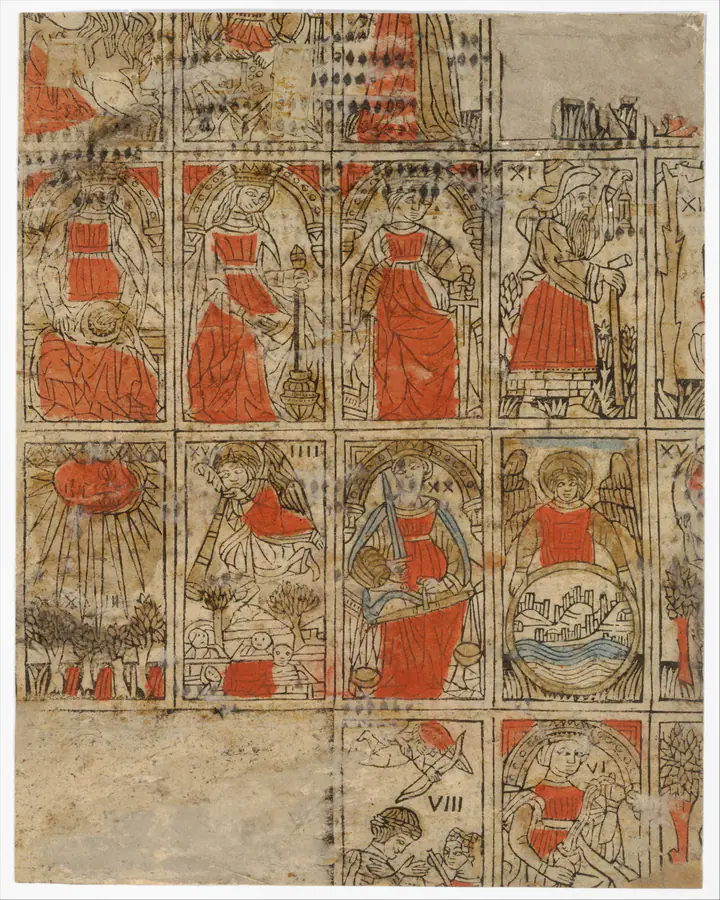
An uncut sheet of tarocchi cards, ca. 1500 — woodcut with stencil colour. Cards, not a divination deck, and printed nearly three centuries before tarot reading begins. The Metropolitan Museum of Art, New York. Open Access (CC0).
One caveat that has to travel with every one of those findings. Each is not found, not proved absent. Nineteenth-century printing renders the long s as f, and OCR turns that into something else again, so a literal phrase search can miss text sitting right there on the page. "I could not find an origin" is the claim. "No origin exists" is not.
Reading the "yes, but"
Every page teaching this method defines the middle state the same way: the timing is not right, information is missing, the situation has not settled. Those are real readings. There is a fourth meaning, though, and it is the one that changes what you do next.
A split draw usually means your question was two questions.
If you asked "Should I take the offer?", you asked at least two things: do I want it, and is it good for me. A deck that answers 2–1 has answered both, badly, because you only gave it one slot. The split is not the spread being coy. It is a report on the question.
Here is the test, in four questions. Ask them in order, and stop at the first one that lands.
Could the two halves be answered differently and both be true?Do I want it — yes; is it good for me — no. Then it is two questions, and you should ask them one at a time.
Does the question contain a hidden condition? An if, a when, an until — "should I take it if they will not move on the salary?" That is not a binary. It is a decision tree, and the tree is the useful part.
Is part of the answer in someone else's hands? Then no spread can close it, and the split is the deck declining to pretend otherwise.
Would you actually act differently on a yes than on a no? If not, you do not have a decision. You have a worry, and worries do not need a spread.
Then turn the verdict into something you can do. The useful half of a split is the condition, so finish the sentence rather than the number:
"Yes, if ..." — the reversed card names what has to be handled first.
"No, until ..." — the upright card names what would change the answer.
A verdict you cannot attach to a next step is a mood, not an answer. Write the sentence down: the verdict, the reason, and the condition that would change it.
When a yes/no question is the wrong instrument
Some closed questions cannot be closed by a spread, not because the cards are weak but because the question is pointed at the wrong thing.
Another person's mind
You cannot ask what someone else thinks, feels or will do. Not because the cards refuse, but because the question contains nothing you can check: the answer lives inside another person and nowhere else, so whatever comes up will be your own hope read back to you in a nicer font. Ask about your side of it instead — what you are getting from the situation, what you are waiting for, what you would do with either answer. And treat anyone who offers to read another person's mind for money as selling something.
Medical, legal and money questions
A spread is not a diagnosis, a legal opinion or a financial projection. "Is this treatment working", "do I have a case", "should I move my savings" are not card questions; they are questions for a doctor, a lawyer and an accountant, and a confident "no" from a card can cost you real health or real money. A reading is a good place to work out what you are afraid of and what you actually want, which is often the thing standing between you and asking the right professional. It is a bad place to get the answer itself.
Timing questions
"When" is the thinnest thing a reading gives you. That is a report on how badly dates hold up, not a rule about cards. If you want a when, ask instead what is in the way and what would clear it — you get something you can act on this week, and a sense of timing usually falls out of it anyway. There is a historical footnote here worth knowing: the one place counting genuinely mattered in the 18th century was in producing a number, usually of years. Nobody was counting to get a yes.
The question you have already decided
If you already know what you are going to do, you are not asking for information. You are asking for permission. That is worth noticing, and it is the cheapest way to make a reading worthless, because you will only accept one of the two answers.
Questions that work, and how to rewrite the ones that don't
A closed question is not a bad question. The failures come in a handful of shapes, and nearly all of them are fixable in one sentence.
Instead of this
Ask this
Why it changes the answer
"Will things work out?"
"Is the approach I am taking actually working?"
No situation, no choice, nothing to check. There is nothing for a spread to be about.
"Does she still love me?"
"Am I the one holding this together?"
A question about someone else's mind has nothing in it you can act on or test.
"Should I take the offer?"
"Is my hesitation about the offer, or about leaving?"
The original is two questions. Split it, and a split draw stops being a hedge.
"When will I get a new job?"
"Is my approach to the search working?"
Dates are the least reliable thing a reading gives. Method questions are answerable this week.
"Is this the right treatment for me?"
Ask a doctor, not a deck
A spread is not a diagnosis, and a card cannot carry that decision.
The same rewrite in the shorter form this site uses elsewhere:
❌ "Will I be happy this year?"
✅ "Does staying where I am cost me more than leaving would?"
❌ "Should I keep going?"
✅ "Is this still working, or am I just not ready to stop?"
❌ "Is this a good time to start?"
✅ "Do I have what I need to start?"
Four things a closed question needs
One subject: you. Not another person's feelings and not a prediction about the world.
One decision. If you can hear two questions in it, it is two.
Something you can act on within a month. If the answer cannot change what you do next, it is not a decision question.
An answer you would accept either way. If only one of the two answers is acceptable to you, you do not have a question. You have a preference with a deck in front of it.
What to do with the answer
The reading ends and the decision is still yours. A card is a prompt, not a verdict. That is not a disclaimer bolted onto the end — it is where the method's value actually sits, because the card gives you a shape for something you already half knew and had not said out loud yet.
So do the one thing almost nobody does. Write four lines down:
The question, word for word, before you draw.
The verdict, and the condition that came with it.
What you are going to do about it.
The date you will look at this again.
Nothing in this article is more useful than those four lines, and here is why they matter. In 1949 Bertram Forer handed 39 students a "personal" personality profile. All 39 profiles were identical. Thirty-eight of the 39 rated it 4 or 5 out of 5 as a description of themselves, a mean of about 4.3. You are the person most likely to be convinced by a reading about you, including when the reading is generic — which is exactly why the record has to be written before the outcome rather than after it.
There is a second reason. Most people test a belief by looking for the cases that should confirm it. That is not stupidity; when information is expensive, it is often a good strategy. It is also why the misses need to be written down as carefully as the hits, because a hit you remember and a miss you forget will convince you of anything.
And the honest state of the evidence, since you will not read it anywhere else on a page like this: I could not find a peer-reviewed experimental study of tarot reading's accuracy in either direction. That is a gap, not a verdict. What does exist is careful work on divination as a decision procedure — Evans-Pritchard's 1937 study of the Azande oracle is the classic account of an oracle used to settle real disputes — and its argument is that the practice is coherent and socially useful, never that it is accurate. No citable research says the cards work. None says they do not. So check your own, and be suspicious of any page that tells you the method "can be surprisingly accurate" without once suggesting you write the result down.
Try it before you pay for it
If you want to run the method above, any 78-card deck will do. If you do not have one to hand, the free tarot draw deals a full 78-card deck in your browser: hold your question in mind, choose a spread, and draw. It is free, everything runs on your device, and nothing is sent to us or saved.
Be clear about what it is, though. It is not a yes/no tool. It offers three spreads — one card, three cards read as past, present and future, and five cards — and it does not hand you a verdict. Use it to look at a question properly. If you want a count, run the method above with a rule you decided in advance.
One honest note if you do decide to count with it: it flips each card independently, so roughly half come up reversed, and each of the 78 cards carries its own written reversed meaning rather than a generic "this is the opposite". That is exactly the 50/50 case in the arithmetic above, so the tally will be a coin — but the cards will still say something, because the meaning is where the content was all along.
And if you would rather have a person in the room, the 15-minute private reading is fifteen minutes on a single question — its own description is "One question you want clarity on, answered directly and without padding", which is the exact shape this article is about. Sessions start at $100, or EGP 1,500 if you are booking from Egypt. The final amount is shown in Egyptian pounds before you confirm, and the full list of readings covers the 30- and 60-minute sessions as well.
Questions people ask
Is there a tarot card that always means yes?
No, and the lists that claim otherwise disagree with each other. The Ten of Wands is a no on one widely-read table, a yes under another page's even-numbered rule, a no under a third page's majors-and-minors split, and irrelevant under a fourth method that counts aces. Only one of the four names any source at all, and it is a 2017 trade book rather than an origin for the rule. Card meanings are worth learning properly — they are most of what a reading actually is — but "this card means yes" is a label somebody chose, not a property the card arrived with.
Does a reversed card always mean no?
It is a convention, not a property of the card, and the field does not agree on it. One popular guide says a reversed card is a no and "it doesn't even matter what the card is"; another refuses outright — "a reversed card is not always the upright answer flipped". Historically, reversals were read as meanings rather than signals: Etteilla applied reversed meanings to playing cards in 1770 and to tarot in 1783, and Waite printed 126 reversed meanings in 1911, every one of them a description rather than a yes or a no. If you use the flip rule, use it because you chose it, and choose it before you deal.
How many cards should I draw for a yes or no answer?
One, three or five. Three is the version that also tells you why, which is why this article uses it. If you are counting orientations, use an odd number: an even count can tie, and a tie is a question about your rule rather than about your question. One thing worth knowing before you choose: by symmetry, any odd number with a strict majority rule returns yes with the same probability when reversals are equiprobable. Five cards are not more decisive than three. They are a longer way to say the same coin.
Can I ask the same question twice?
Not as a second opinion. Re-asking until you like the answer turns the reading into a negotiation, and you will remember the draw you preferred. If the first draw came out split, that is information rather than failure — the fix is to rewrite the question, which is narrower than simply drawing again. Rewording a question you got wrong is repair. Repeating a question you did not like is not.
Is the yes or no tarot method ancient?
No. The parts you would expect to be old really are old: counted-card layouts go back at least to the 1840s, and closed questions answered from named cards are documented by 1900. The parts taught today are the untraceable ones — reds yes and blacks no, count to thirteen, count the pips have no source I could find in any canonical tarot text or pre-20th-century manual. Tarot divination itself only begins in the 1780s, which is a hard ceiling on how old any tarot yes/no method can be. None of that makes the method bad. A modern convention, honestly labelled as one, is a perfectly good tool; the only thing refuted by the evidence is a modern convention sold as ancient tradition.
📚 Sources & Historical References
Primary texts and historical manuals:
A. E. Waite, The Pictorial Key to the Tarot (London: William Rider & Son, 1911; the scan used is the 1922 reprint) — Wikisource. Part III, "The Outer Method of the Oracles", is the section searched for a yes/no method.
P. R. S. Foli, Fortune-telling by Cards (New York: Diehl, Landau & Pettit, 1900) — Internet Archive. The counting chapters and "Important Questions" are the relevant parts.
The Original Norwood Gipsy; or, The Fortune-Teller's Sure Guide (Derby: Thomas Richardson, c.1840), attributed to Margaret Finch — Internet Archive.
Mohammed Ali, Telling Fortunes by Cards, edited by Carleton B. Case (Shrewesbury, c.1916) — Project Gutenberg #42008.
Eden Gray, Mastering the Tarot (New York: Signet, 1971), Lesson 14, the Three Aces spread.
Michael Dummett, The Game of Tarot (1980), p. 96, on tarot divination beginning in the 1780s; and Decker, Depaulis and Dummett, A Wicked Pack of Cards (1996).
Abraham Hyatt, Folk-Lore from Adams County, Illinois (1935), entries 6807 and 9054 — the earliest binary red/black verdict found, and a nine-card count.
Research on judgement and on divination:
Bertram R. Forer, "The fallacy of personal validation: a classroom demonstration of gullibility" (1949), Journal of Abnormal and Social Psychology 44(1), 118–123 — doi:10.1037/h0059240.
Joshua Klayman and Young-Won Ha, "Confirmation, disconfirmation, and information in hypothesis testing" (1987), Psychological Review 94(2), 211–228 — doi:10.1037/0033-295X.94.2.211.
Edward E. Evans-Pritchard, Witchcraft, Oracles and Magic among the Azande (Oxford: Clarendon Press, 1937).
Jennifer A. Whitson and Adam D. Galinsky, "Lacking control increases illusory pattern perception" (2008), Science 322(5898), 115–117 — doi:10.1126/science.1159845.
On the negative findings: every "I could not find" in this article means exactly that, and not that no source exists. Nineteenth-century printing and its OCR render the long s as f, so a literal phrase search can miss text that is present on the page.
The short version
•Yes/no tarot works, but the tally is the weak part. With upright counted as yes and reversed as no, a majority rule answers yes half the time whatever you asked.
•The rules taught today — count to thirteen, reds yes / blacks no, count the pips — have no source I could find in a canonical tarot text or a pre-20th-century manual.
•Three cards read as situation, what decides it, and where it is heading tell you why. Ask one closed question you can act on.
•A split draw usually means your question was really two questions. That is the most useful thing a "maybe" can tell you.
•Write the verdict down with a date and look again later. Almost nobody does, and it is the only way to find out whether your readings work.