Zodiac compatibility is one of the most common questions people bring to astrology: who fits with whom, and what does a pairing say about a relationship? This guide explains what a compatibility comparison can show, what the zodiac compatibility calculator measures, and why neither a chart nor a sign can decide whether a relationship is safe.
Sun-sign compatibility and birth-chart compatibility
Most articles about compatibility compare sun signs: Taurus with Cancer, Libra with Gemini, and so on. That is the broad version. It takes one point from each person's chart, the sign of the Sun, and gives a general picture of temperament within the astrological tradition.
Our services
Private 1:1 Tarot Reading with Fardous
Direct, personal, and focused clarity on your most pressing question.
A birth-chart comparison goes further. A full chart places the Sun, the Moon, the planets and the angles for the moment and place of birth, so two charts can be compared in much more detail. The calculator on this site works that way: it sets every planet of one chart against every planet of the other, and reports the result as six scored dimensions, with the aspects behind each score shown. That is the tool's way of organising an astrological reading. It is not a scientific test, and it is not a formula that every astrologer would accept.
The six dimensions, and why one number hides too much
The calculator scores six dimensions separately: attraction, emotional understanding, communication, long-term stability, shared growth and intensity. The compatibility page says each one lists the aspects that produced it, so a result can be checked rather than simply believed. That is the right instinct. A single percentage invites you to stop thinking. Six separate scores invite questions.
Consider what separate scores can reveal. A pair can have strong attraction and intensity but weaker communication. That combination often describes a connection that is quick to form and harder to talk through. Another pair can have calm communication and long-term stability but less spark. Neither profile is a verdict. Each one describes where effort may be needed, and where the two people might want to talk.
Our services
Private 1:1 Tarot Reading with Fardous
Direct, personal, and focused clarity on your most pressing question.
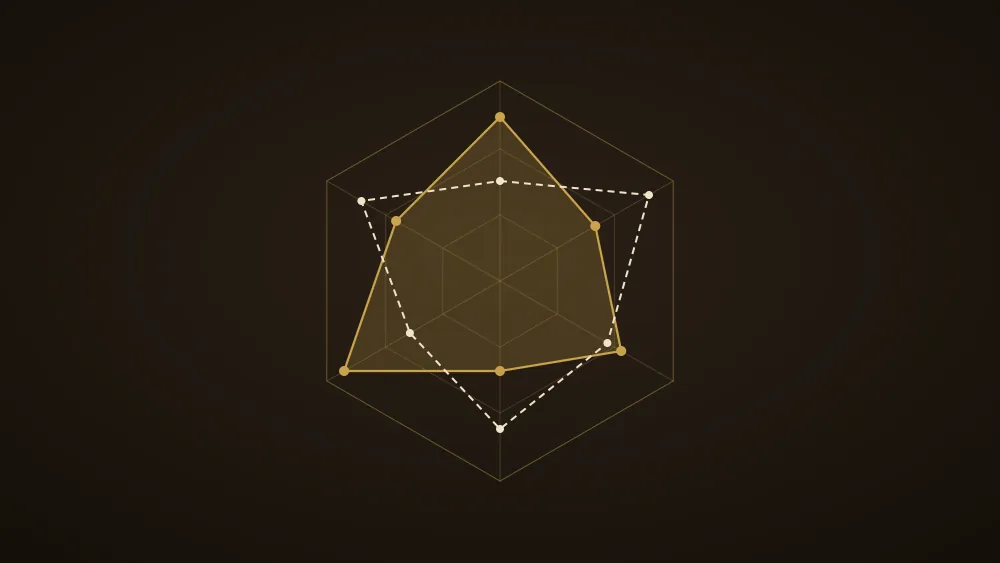
The image above is illustrative: two shapes compared across six axes, with no numbers attached. Read it as you would read a shape, not a score. Where one shape reaches further, it shows a difference in emphasis. Where the two shapes overlap, they show common ground. Neither part tells you what the two people will do.
What astrology can say, and what it cannot
Astrology is a symbolic language. It can describe temperaments, styles of loving and arguing, and the kind of attention two people tend to pay to each other. Those descriptions can be useful for reflection. They can help a couple name a difference without blaming either person for it.
Astrology cannot establish whether a relationship is safe, healthy, destined to last, or worth continuing. A chart cannot see what happens in private, how one person speaks when frustrated, or whether one partner is afraid of the other. Those facts come from behaviour, and from the people involved.
So two people with a low compatibility score can build a stable and respectful relationship. Two people with a high score can still hurt each other. The number describes a chart. It does not describe the conduct of two people.
Using compatibility to start a better conversation
The most useful thing a comparison can do is start a conversation. Instead of asking "are we compatible?", ask questions that produce information you can use:
How does each of us behave when we are stressed or exhausted?
What does each of us need to hear after a disagreement?
Which decisions do we want to make together, and which should each person make alone?
How do we repair a hurt? Who starts, and how do we know it is over?
What does each of us do with time apart, with friends, and with money?
The answers are worth more than any chart. They reveal patterns that you can see over time, which is exactly the kind of evidence a chart cannot provide.
Safety is about behaviour, not sign or score
A relationship's safety is not a question for the sky. It is a question about how people treat each other, again and again. The World Health Organization defines intimate partner violence as behaviour by an intimate partner or ex-partner that causes physical, sexual or psychological harm. Its definition lists physical attacks, sexual pressure or coercion, psychological abuse and controlling behaviours (WHO fact sheet on violence against women).
Our services
Private 1:1 Tarot Reading with Fardous
Direct, personal, and focused clarity on your most pressing question.
Many people also describe other warning signs in their own words, and they deserve attention whatever a chart says:
Threats, intimidation, or punishment for disagreeing
Humiliation, insults, or constant put-downs
Pressure to cut off friends or family, or to stop seeing people you trust
Control over money, work, travel, or who you may speak to
Checking your phone, location or messages without agreement
Pressure to have sex, or to do anything you have said you do not want
Feeling afraid to say no, or to raise a concern
These signs describe conduct. If you recognise them, the safety question has already been answered by what is happening, not by a compatibility score.
When a high score is no reason to stay quiet
A high score is not a reason to ignore harm. If someone treats you badly, the chart does not change that. Chemistry and shared interests are real, and they can make a harmful relationship feel close, which is one reason people find it hard to step back. Pay attention to the pattern, not to the forecast.
When a low score is no reason to leave
A low score is not a verdict on two real people. Differences in temperament are common, and many long relationships were built by people who approach life in very different ways. If a difference causes friction, the useful question is whether you can talk about it, respect each other's limits, and repair what goes wrong. A chart cannot measure that.
If a relationship leaves you feeling unsafe
If you feel unsafe, your experience matters more than any chart. Consider speaking with someone you trust, such as a friend, a relative or a colleague, and telling them what is happening. If you are in immediate danger, contact your local emergency number. For ongoing support, look for a local service that works with people experiencing relationship abuse. Those services can help you plan your next steps at your own pace.
You do not need to prove anything before you ask for help. Writing down what happened, with dates, can help you think clearly later, and whether to share it is your decision.
Our services
Private 1:1 Tarot Reading with Fardous
Direct, personal, and focused clarity on your most pressing question.
The score describes a chart. The relationship is described by how two people treat each other.
Common questions about zodiac compatibility
Is zodiac compatibility accurate?
Compatibility is a symbolic comparison. It can describe differences in temperament and give a vocabulary for conversations, but it does not measure how well two people will get on, and it cannot predict the future of a relationship.
Which zodiac signs are most compatible?
There is no single agreed list. Traditions differ, and sun-sign pairings are a broad, popular shorthand. A birth-chart comparison is more detailed, and it still describes possibilities rather than outcomes. Be wary of any article that presents one list as settled fact.
Can a compatibility calculator predict marriage or a breakup?
No. A calculator compares two charts and reports scores with the aspects that produced them. It cannot know what two people will choose, how they will treat each other, or what circumstances they will face.
Does a birth-chart comparison need the exact time of birth?
A full birth chart depends on accurate birth details, including the time and place, because the Moon and the angles move quickly. A sun-sign comparison needs only the date. More exact details give a more detailed chart, but detail is not the same as certainty.
What counts as a toxic relationship?
Avoid using the word as a chart verdict. Look instead at repeated behaviour: control, threats, humiliation, isolation, fear and pressure. If those patterns are present, the relationship deserves attention, whatever the signs say.
Keep the chart as a question, and the behaviour as the answer
Use zodiac compatibility to ask better questions about your differences. Use the six dimensions to see where you may need to talk more. Then look at how the relationship actually works: honesty, respect, the freedom to say no, and the willingness to repair what goes wrong.
If you want a personal reading built around your own birth chart and your own question, private readings are where that work happens, one to one.
The short version
•A compatibility comparison describes differences in temperament. It cannot decide alone whether a relationship is safe, healthy or destined.
•The calculator scores six dimensions: attraction, emotional understanding, communication, long-term stability, shared growth and intensity.
•Read the scores as questions. A low or high dimension points to a topic to talk about, not to whose fault it is.
•Safety is judged by repeated behaviour: threats, humiliation, control, isolation, fear and pressure. A chart cannot see those.
•A high score is no reason to ignore harm, and a low score is no reason to end a relationship that works.